Home › Private blood tests › Difficult veins and needle phobia
Blood Tests for Difficult Veins and Needle Phobia in Birmingham
If you have been told your veins are hard to find, if earlier blood tests have taken several attempts, or if needles simply frighten you, you are far from alone, and you do not have to put the test off. At OneMedicine Private Surgery in Kings Heath, Birmingham, your blood is always taken by a doctor with more than 20 years of experience taking blood, with a butterfly needle, in a private room, without a queue behind you. And if the doctor cannot obtain a sample, you are not charged.
- A doctor takes every sample
- Over 20 years of experience
- Butterfly needles
- No sample, no charge
- Ages 12 and over
- Lie down if you prefer
- CQC-registered
- Free parking at the rear
What we do differently
- A doctor every time. The GP who reviews your results is the person who takes the sample, and has been taking blood for more than 20 years. It is one appointment with one clinician.
- Butterfly needles. A finer, shorter needle held at a shallow angle, made for small, deep or fragile veins.
- Time. Your appointment is your own slot. Nobody is waiting outside the door, so there is no reason to hurry.
- You are listened to. If you know which arm, which vein or which position works for you, say so, and that is where we start.
- No sample, no charge. No one can promise a sample on every attempt. If the doctor cannot obtain one, your payment is refunded in full.
If your veins are hard to find
Some people have veins that are small, deep, mobile or easily collapsed. It is more common if you are dehydrated or cold, after repeated blood tests or treatment through a drip, with some long-term conditions, and it often simply runs in families. It says nothing bad about you, and it is not something you are doing wrong.
Before you come
- Drink plenty of water in the two hours before. Water is fine even for a fasting test.
- Keep your arms warm on the way in: long sleeves, a coat, gloves in winter.
- Wear sleeves that roll up easily above the elbow.
- Unless you are fasting for the test, eat normally.
When you arrive
- Tell the doctor your veins are difficult, before the tourniquet goes on.
- Say which arm and which vein has worked before, and which has not.
- Ask to lie down if you tend to feel faint.
- Ask for a pause at any point. You are in charge of the pace.
If you are nervous of needles
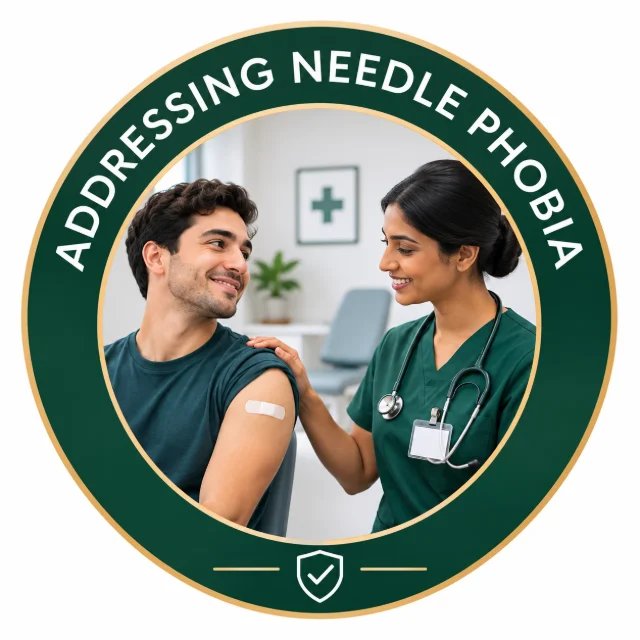
Fear of needles is one of the commonest fears there is. Tell us when you arrive. You will not be the first person that day to say it.
- Look away, or watch. Whichever you prefer. Tell the doctor whether you want each step explained or would rather talk about something else entirely.
- Bring someone. A friend, partner or parent is welcome in the room.
- Lie down. If you have ever fainted or felt light-headed at a blood test, have this one lying down.
- Headphones are fine. Music or a podcast helps a lot of people.
- It is quick. The needle is usually in for less than a minute.
We do not provide numbing cream, and we are a GP clinic, not a therapy service: if fear of needles is stopping you from getting medical care, talking therapy (CBT) through NHS Talking Therapies is effective and you can refer yourself.
What happens at the appointment
- You arrive at your own time slot. 1 High Street, Kings Heath, B14 7AR, opposite Kings Heath station, with free parking at the rear.
- You tell the doctor what has and has not worked before. Sit or lie down, whichever you prefer.
- The doctor finds the best vein and takes the sample with a butterfly needle. Most people feel a sharp scratch for a second or two.
- You rest for as long as you need. Press on the cotton wool for a couple of minutes to limit bruising.
- Results come by email with a doctor’s comments, for most tests within 24 hours.
Children and teenagers
We take blood from children aged 12 and over at the Birmingham clinic. Under-16s come with a parent or guardian, who stays in the room; 16 and 17 year olds may come alone. The same doctor, the same butterfly needle and the same no-sample-no-charge rule apply. For a child under 12, speak to your GP about a children’s blood test service.
Popular blood tests
Every test is taken the same way. There is no blood-draw fee at the Birmingham clinic, and a difficult sample costs nothing extra.
See all private blood tests and prices
Questions people ask
Can I have a blood test if my veins are hard to find?
Yes. Tell us when you arrive that your veins are difficult, and which arm or vein has worked before. At our Birmingham clinic a doctor takes every sample and uses a butterfly needle, a finer needle made for small, deep or fragile veins. We take our time. No one can promise a sample on every attempt, so if the doctor cannot obtain one you are refunded in full.
Who takes my blood?
At OneMedicine in Kings Heath, Birmingham, your blood is always taken by a doctor, the same GP who reviews your results, with more than 20 years of experience taking blood. If you book one of our UK partner clinics or a home visit instead, the sample is taken by a trained phlebotomist from our laboratory partner.
What is a butterfly needle?
A butterfly needle is a short, fine needle with two small plastic wings and a length of soft tubing. The wings let the doctor hold it steady at a shallow angle, and the tubing means the needle does not move when the sample tubes are changed. It is the usual choice for small, deep or fragile veins, for veins in the hand, and for children.
How big is the needle for a blood test, and what gauge is it?
Smaller than most people expect. Butterfly needles for a blood test are usually 21 or 23 gauge, which is less than a millimetre wide, and about two centimetres long. Only the tip goes into the vein.
Does a blood test hurt?
Most people feel a sharp scratch for a second or two as the needle goes in, then pressure rather than pain while the sample is taken. A small bruise afterwards is common and fades in a few days. It is not pain-free, but it is brief.
How long is the needle in for?
Usually less than a minute. The time depends on how many sample tubes your tests need: one or two tubes take a few seconds each, a larger health screen takes a little longer.
How deep does the needle go?
A few millimetres. The veins used for a blood test, in the crease of the elbow or the back of the hand, lie just under the skin, so the needle goes in at a shallow angle and only its tip enters the vein.
How can I get a blood test if I have a needle phobia?
Tell us when you book or when you arrive; it is very common and nothing to be embarrassed about. You can lie down, look away, bring someone with you, listen to something on headphones, and ask the doctor to say nothing about what is happening or to talk you through each step, whichever you prefer. The appointment is one to one with a doctor in a private room. If your fear is severe enough that you avoid medical care, talking therapy (CBT) works well for needle phobia and is available through NHS Talking Therapies.
I faint or feel dizzy at blood tests. What can you do?
Tell the doctor before the sample is taken and you can lie down for it, which prevents most faints. Eat and drink normally beforehand unless your test needs fasting, and drink water either way. A technique called applied tension also helps: tense the muscles of your legs, buttocks and the arm not being used for 10 to 15 seconds, relax for 20 to 30 seconds, and repeat about five times. Afterwards, stay lying down until you feel well; there is no rush to leave.
Do you offer numbing cream?
No, we do not provide numbing cream at the clinic. If you want to use your own, these creams need to be applied well before the appointment to work.
Can I have a blood test without a needle?
Not for the tests we offer. Finger-prick kits exist for a small number of tests, but they give a very small sample that is not suitable for most blood panels and is more likely to need repeating. We take a sample from a vein, which gives the laboratory enough blood to run every test you have booked.
Are blood test needles reused?
Never. Every needle is sterile, single-use and disposed of in a sharps bin straight after your sample.
What happens if you cannot get a blood sample?
If the doctor cannot obtain a blood sample, you are not charged: your payment is refunded in full. We will also tell you honestly what we found and what might help on another day, such as better hydration or a warmer arm.
Can my child have a blood test with you?
We take blood from children aged 12 and over at the Birmingham clinic, and under-16s come with a parent or guardian. The online booking will not accept a date of birth under 12. For a younger child, speak to your GP about a children’s blood test service.
How should I prepare if my veins are difficult?
Drink plenty of water in the two hours before your appointment (water is fine even for a fasting test), keep your arms warm on the way in, and wear sleeves that roll up easily. Tell the doctor which arm and which vein has worked in the past.
Does it cost more if my veins are difficult?
No. The price is the price of your tests, from £40, and there is no blood-draw fee at the Birmingham clinic. Taking longer over a difficult sample costs you nothing extra.
Is this available at your partner clinics or for home visits?
What is described on this page applies to our own clinic at 1 High Street, Kings Heath, Birmingham, where a doctor takes the blood. At UK partner clinics and on home visits a trained phlebotomist takes the sample; if you know your veins are difficult and you can travel, the Birmingham clinic is the one to book.
Read more
- Preparing for a Blood Test: Fasting and Practical Tips
- How Much Does a Private Blood Test Cost in the UK?
- Blood Test Results Explained: An A–Z Guide
- Private blood tests in Birmingham and UK-wide
Book a blood test at the Birmingham clinic
OneMedicine Private Surgery, 1 High Street, Kings Heath, Birmingham B14 7AR, opposite Kings Heath station, free parking at the rear. CQC-registered. Not sure which test you need, or want to talk it through first? Call or WhatsApp 07777 238 999.