Private Spirometry and Lung Function Test in Birmingham
Spirometry (lung function test) in Birmingham, £95 with a GP's interpretation and your report on the day
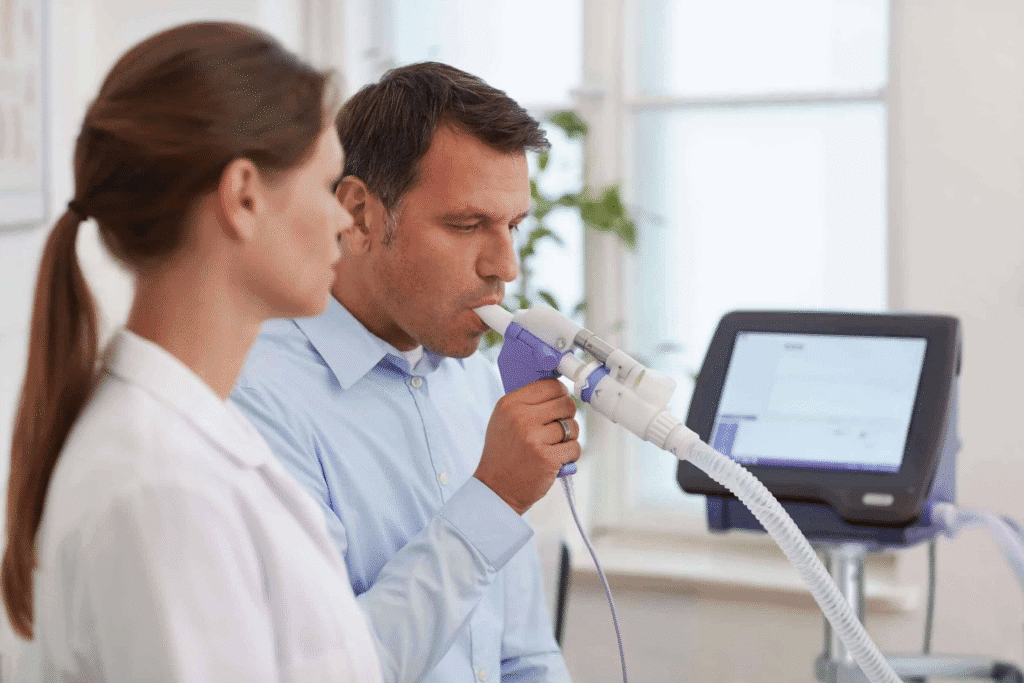
Spirometry is the breathing test used to diagnose and monitor asthma and COPD. You blow into a spirometer, it measures how much air your lungs hold and how fast you can empty them, and Dr Ibrar Ahmed explains what the numbers mean before you leave. No referral needed, no NHS waiting list, and a reversibility test if your symptoms point to asthma.
Includes: a 30-minute appointment, the full spirometry trace (FEV1, FVC, FEV1/FVC ratio and flow-volume loop against your predicted values), your lung age, a GP's interpretation on the day and a written report emailed to you. Reversibility testing: £175 (see below).
Book a spirometry test- Results explained on the day
- GMC-registered GP
- No referral needed
- Ages 16 and over
- CQC-registered clinic
- Free parking at the rear
When a spirometry test is worth doing
Wheeze, chest tightness or breathlessness
Symptoms that come and go, are worse at night or after exercise, or started after a chest infection and never settled. Spirometry shows whether your airways are narrowed and whether that narrowing opens up with an inhaler.
A cough that will not go
A cough lasting more than eight weeks deserves a lung function test, particularly if you smoke, used to smoke, or bring up phlegm most mornings.
Smokers and ex-smokers over 35
COPD is diagnosed with spirometry and nothing else. If you are over 35 with a smoking history and any breathlessness, cough or chest infections, the test either rules it out or catches it early, when stopping smoking and the right inhaler make the biggest difference.
Monitoring, work and fitness
A yearly check if you already have asthma or COPD, a baseline before a job with dust or fume exposure, a pre-operative assessment, or simply to know your lung age before you quit.
What the test involves
- A short history. Your symptoms, inhalers, smoking history and anything that could affect the result. Height and weight are measured, because your predicted values depend on them.
- The blows. With a soft clip on your nose you take the deepest breath you can and blow out as hard and as long as possible into the mouthpiece. You repeat it until three blows match closely, usually three to five attempts. It is tiring for a few seconds but not painful.
- Reversibility, if booked. You take four puffs of a salbutamol reliever through a spacer, wait 15 to 20 minutes, and blow again. A clear improvement supports asthma; little change points towards COPD or another cause.
- Your results, explained. Dr Ahmed goes through the trace with you: whether the pattern is normal, obstructive or restrictive, how it compares with people of your age, sex and height, and what to do next. You leave with a written report, emailed the same day, which your NHS GP or employer can use.
How to prepare
- No smoking or vaping for 24 hours if you can, and for at least one hour before
- No alcohol for four hours and no large meal for two hours before
- No vigorous exercise in the 30 minutes before, and wear loose clothing you can breathe in
- Bring your inhalers and a list of your medicines. Keep taking them unless we have asked you to pause: for a diagnostic test we may ask you to hold a reliever inhaler for four to six hours and a long-acting inhaler for 12 to 24 hours, but never stop one if you need it
- Bring any previous spirometry or peak flow readings so we can compare
What the numbers mean
Spirometry reports three figures. FVC (forced vital capacity) is the total air you can blow out. FEV1 is the air you blow out in the first second. The FEV1/FVC ratio shows how freely air leaves your lungs. Each is compared with the value predicted for your age, sex, height and ethnicity.
| Pattern | What the trace shows | What it usually means |
|---|---|---|
| Normal | FEV1, FVC and the ratio all within the expected range | No evidence of asthma or COPD on the day. Asthma can still be present between flare-ups, so a normal result with typical symptoms may lead to a peak flow diary or a reversibility test. |
| Obstructive | Ratio below 0.70, or below the lower limit of normal for your age | Narrowed airways. If the FEV1 improves by 12% and 200 ml or more after the inhaler, that supports asthma; if it does not, COPD or another cause is more likely. |
| Restrictive | FVC reduced with a normal or high ratio | The lungs are not filling fully: stiff lungs, chest wall or weight-related causes. This pattern needs full lung function tests in a hospital laboratory, which we arrange by referral. |
For COPD, the FEV1 as a percentage of predicted grades the severity: 80% or more is mild, 50 to 79% moderate, 30 to 49% severe and under 30% very severe. Your lung age, the age at which your FEV1 would be normal, is on the report; for smokers it is often the number that prompts a quit date.
Spirometry with reversibility, £175
If asthma is the question, book the reversibility test. It is the same spirometry, then a reliever inhaler through a spacer and a repeat set of blows 15 to 20 minutes later, with Dr Ahmed interpreting both. It is the test the BTS, NICE and SIGN asthma guideline uses to confirm reversible airflow obstruction, and it tells you in one visit whether an inhaler is likely to help. Allow 45 minutes.
Book spirometry with reversibility
Which test do you need?
Breathlessness is not always the lungs. Anaemia, thyroid problems and heart disease all cause it, so the GP may suggest a full blood count or an ECG alongside spirometry. A chest X-ray, when needed, is arranged by referral to a local imaging centre.
Questions people ask
How much does a spirometry test cost?
£95 at OneMedicine, including the GP's interpretation on the day and a written report. Spirometry with a reversibility test is £175. There is no separate consultation fee.
What is spirometry and what does it show?
Spirometry measures how much air you can blow out of your lungs and how quickly. It produces three key numbers: FVC, the total air blown out; FEV1, the air blown out in the first second; and the FEV1/FVC ratio. Together they show whether your airways are narrowed (an obstructive pattern, as in asthma and COPD) or your lungs are not filling fully (a restrictive pattern), and how your lung function compares with people of your age, sex and height.
Is spirometry the test for asthma?
It is the main one. Asthma narrows the airways in a way that varies and reverses, so the diagnostic test is spirometry with reversibility: blow, take a reliever inhaler, blow again. An FEV1 improvement of 12% and 200 ml or more supports asthma. Because asthma comes and goes, a normal spirometry on a good day does not rule it out, and the GP may add a peak flow diary or a FeNO test by referral.
Is spirometry the test for COPD?
Yes. COPD is diagnosed only by spirometry: an FEV1/FVC ratio below 0.70 after a bronchodilator, in someone with symptoms and a risk factor such as smoking. The FEV1 as a percentage of predicted then grades it mild, moderate, severe or very severe, which guides treatment. If you are over 35, smoke or used to, and get breathless or cough, this is the test to have.
How long does a spirometry test take?
About 30 minutes for spirometry alone, including the history, the blows and the explanation of your results. Spirometry with reversibility takes about 45 minutes because of the 15 to 20 minute wait after the inhaler.
How should I prepare? Can I eat, smoke or use my inhaler?
Avoid smoking or vaping for 24 hours if you can (at least one hour), alcohol for four hours, a large meal for two hours and hard exercise for 30 minutes before. Wear loose clothing. Bring your inhalers and keep using them unless we have asked you to pause one for a diagnostic test; never stop an inhaler you need. If you have had a chest infection in the last four to six weeks, rebook.
Does spirometry hurt? Is it safe?
It does not hurt. Blowing out hard several times can leave you briefly light-headed or make you cough, and that passes within a minute. The test is postponed after a recent heart attack, pulmonary embolism, collapsed lung or eye, chest or abdominal surgery, and if you are coughing up blood that has not been looked into.
When do I get the results?
On the day. Dr Ahmed interprets the trace with you at the appointment, and a written report with your values, predicted values and lung age is emailed the same day. You can share it with your NHS GP, employer or specialist.
What is a normal FEV1?
There is no single normal figure; FEV1 is judged against the value predicted for your age, sex, height and ethnicity. Around 80% of predicted or more, with a normal FEV1/FVC ratio, is normal. A low FEV1 with a ratio below 0.70 indicates airflow obstruction; a low FEV1 with a normal ratio suggests a restrictive pattern. The report shows your figures beside your predicted ones so you can see where you sit.
Do I need a GP referral?
No. You can book spirometry directly online, and the GP who runs the test interprets it for you. If the result needs further tests, such as full lung function tests, a chest X-ray or a respiratory specialist, we arrange the referral and give you the report to take to your NHS GP.
What is the difference between spirometry and a peak flow test?
Peak flow measures only the fastest speed of air you can blow out, with a hand-held meter, and is useful for monitoring asthma day to day. Spirometry measures the volume and the speed of the whole breath against predicted values and is the test used to diagnose asthma and COPD. Many patients have spirometry once and then use a peak flow meter at home.
Can my child have a spirometry test?
We offer spirometry to patients aged 16 and over, and the online booking will not accept a younger date of birth. For anyone under 16, call us on 07777 238 999 and the GP will advise whether a paediatric referral is the better route.
Do you do full lung function tests, gas transfer or FeNO?
Not at the clinic. We offer spirometry and spirometry with reversibility, which answer most asthma and COPD questions. Lung volumes, gas transfer (DLCO) and FeNO are hospital laboratory tests; if your spirometry suggests they are needed, we arrange the referral.
OneMedicine, 1 High Street, Kings Heath, Birmingham B14 7AR. Opposite Kings Heath railway station, free parking at the rear. CQC-registered.