Treadmill Exercise Stress Test
Private Treadmill Exercise Stress Test (Exercise ECG) in Birmingham
A treadmill exercise stress test, also called an exercise ECG or exercise tolerance test (ETT), records your heart rhythm and blood pressure while you walk on a treadmill. At OneMedicine in Kings Heath, Birmingham, your test is supervised and reported by Prof Jawad Khan, Consultant Cardiologist.
- £250, including the consultant’s written report
- No referral needed: you can book directly
- Report with ECG tracings emailed the same working day
- Accepted for DVLA Group 2, pilot (CAA) and occupational medicals
1 High Street, Kings Heath, Birmingham B14 7AR, opposite Kings Heath station, with on-site parking
How much does a treadmill stress test cost?
The test costs £250. This covers the supervised test, Prof Khan’s written report and your ECG tracings. If the test is for the DVLA or a council licensing authority, we complete the medical forms at no extra charge.
What is a treadmill exercise stress test?
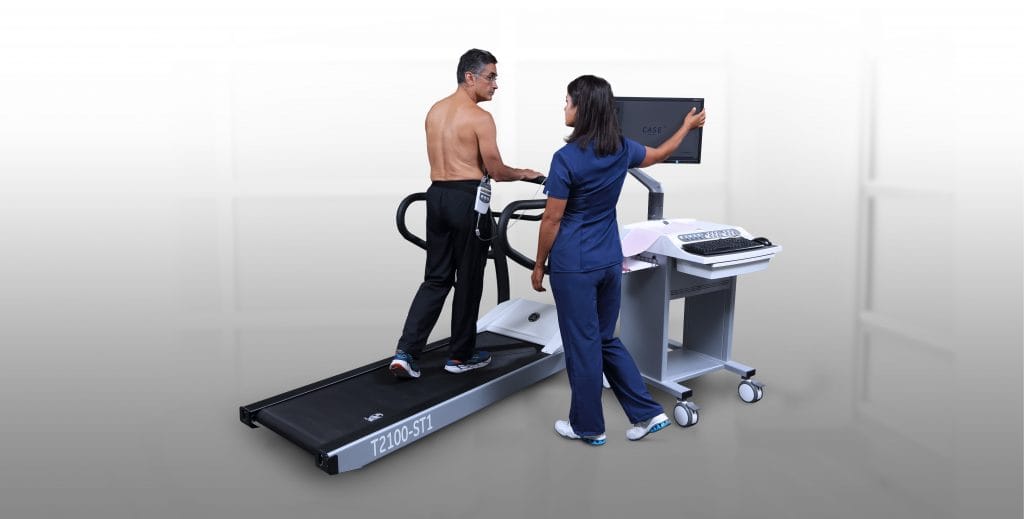
Some heart problems only show when the heart is working hard. A treadmill stress test, sometimes called a stress ECG, monitors the electrical activity of your heart with a 12-lead ECG while the treadmill’s speed and incline gradually increase. It helps detect conditions such as coronary artery disease, where narrowed arteries reduce blood flow to the heart.
It is particularly useful for investigating chest pain, breathlessness or reduced exercise tolerance, and for assessing people with known heart disease.
Who should have an exercise ECG?
The test is recommended if you:
- Have chest pain, breathlessness or palpitations during physical activity
- Have risk factors for coronary artery disease, such as high blood pressure, diabetes, high cholesterol or a family history of heart disease
- Need your heart assessed after a heart attack, angioplasty or bypass surgery
- Need a heart assessment before surgery
- Have noticed you can no longer exercise as you used to
How to prepare for your test
Wear trainers and loose, comfortable clothes you can walk briskly in
Eat a light meal at least 2 hours before
Avoid caffeine, alcohol, smoking and vigorous exercise for 3 hours before
Do not stop any medication unless a doctor has told you to
Tell us if you take a beta-blocker, such as bisoprolol, atenolol or propranolol
Bring a list of your medications, photo ID and your glasses if you wear them
Small patches of chest hair may need to be shaved for the electrodes
Consultant Cardiologist Supervised and Reported £250 · report emailed the same working day
What happens during the test
Your appointment lasts about 45 minutes. The walking itself takes 10 to 15 minutes.
Preparation: electrodes are placed on your chest and connected to a hospital-grade GE CASE stress-testing system. A blood pressure cuff is fitted to your arm.
Exercise: you walk on the treadmill following the Bruce protocol. The speed and incline increase every three minutes.
Monitoring: your heart rate, blood pressure and 12-lead ECG are watched throughout. The test stops if you reach your target, develop symptoms, or ask to stop.
Recovery: monitoring continues while your heart rate settles.
Report: Prof Khan analyses your ECG, blood pressure and symptoms before, during and after exercise.
When to call us before booking
Please call us first if any of these apply. The test may need to be changed, or a consultation booked first.
- Chest pain, chest tightness or breathlessness at rest, or new or worsening symptoms in the last 2 weeks
- A heart attack, stent, heart surgery or a heart-related hospital admission in the last 3 months
- Known severe heart valve disease, heart failure, cardiomyopathy or an aortic aneurysm
- Recent blood pressure readings above 180/100
- Fainting or blackouts during exercise
- A current chest infection or fever
- Pregnancy
- Difficulty walking briskly on a treadmill
- If you have severe chest pain now, call 999.
Treadmill stress test or stress echocardiogram?
A treadmill stress test records your ECG and blood pressure during exercise. An exercise stress echocardiogram (£375) adds ultrasound images of the heart taken before and straight after exercise. The treadmill test is the usual starting point. Licensing bodies such as the DVLA and CAA ask for it by name. If your resting ECG makes an exercise ECG hard to interpret, Prof Khan may advise a stress echocardiogram instead.
FAQ
How long does a treadmill stress test take?
The appointment lasts about 45 minutes. You are on the treadmill for 10 to 15 minutes.
How much does a private treadmill stress test cost?
£250, including the consultant cardiologist's written report and ECG tracings.
Do I need a referral?
No. You can book directly online without a GP letter.
When do I get my results?
Your written report is emailed the same working day as your test.
Is the report accepted by the DVLA and the CAA?
Yes. Tests are run and reported to the DVLA Group 2 standard and the CAA Exercise ECG Test Protocol. Tell us the purpose when you book.
Do I need to stop my beta-blocker?
Not for a DVLA test. For a pilot (CAA) test, your cardiologist may advise pausing it, and only under medical supervision. Never stop medication without medical advice.
Where is the clinic, and is there parking?
1 High Street, Kings Heath, Birmingham B14 7AR, opposite Kings Heath railway station. There is on-site Free parking.
Supervised by Prof Jawad Khan
If you’re experiencing symptoms such as chest pain, breathlessness, or a decline in your exercise ability, the Treadmill Exercise Stress Test can provide valuable insights into your heart health. Early detection of heart conditions through this test allows for prompt treatment and can help prevent serious cardiovascular events.
Take control of your heart health today: book your Treadmill Exercise Stress Test with Prof Jawad Khan at OneMedicine for £250.