Most of us spend the majority of a medical consultation sitting down. But the heart is designed to work — and sometimes important information only becomes apparent when we ask it to work harder.
- What happens during an exercise stress test?
- Exercise testing when you have symptoms
- Exercise testing when you feel well
- Fitness is itself an important health measurement
- What happens to blood pressure during exercise?
- What can heart rate tell us?
- Heart-rate recovery
- Can an exercise test tell me whether my arteries are blocked?
- Exercise testing in established heart disease
- Exercise testing and cardiovascular prevention
- Not everyone needs an exercise stress test
- The heart at rest is only part of the story
An exercise stress test, sometimes called an exercise ECG, exercise tolerance test (ETT) or treadmill test, records how your heart responds as you progressively exercise.
It can be useful when investigating symptoms or known heart disease, but exercise testing can also provide valuable information about fitness, exercise capacity and the body’s cardiovascular response to physical activity.
What happens during an exercise stress test?
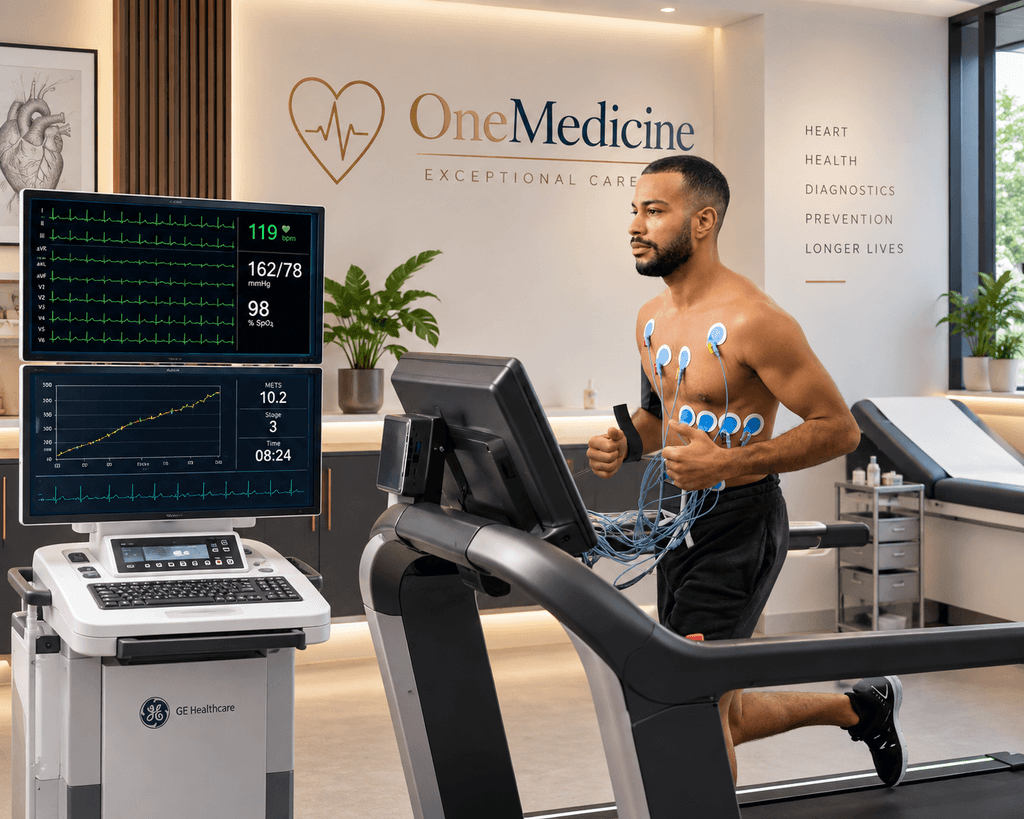
Small electrodes are attached to the chest to continuously monitor the heart’s electrical activity (ECG). Blood pressure and symptoms are also monitored.
You then walk on a treadmill, with the speed and gradient gradually increasing according to a defined exercise protocol.
Rather than simply producing a “positive” or “negative” result, the test allows us to observe several things at the same time:
- Heart rate and rhythm
- ECG changes during exercise
- Blood pressure response
- Exercise duration
- Exercise capacity
- Development of chest discomfort or breathlessness
- Abnormal heart rhythms triggered by exercise
- Heart-rate recovery after exercise
Together, these can provide a useful picture of how the cardiovascular system behaves under physical stress.
Exercise testing when you have symptoms
Some heart-related problems may not be apparent while you are sitting or lying down.
Exercise increases the body’s demand for oxygen. The heart beats faster, blood pressure changes and the cardiovascular system has to deliver considerably more blood to the working muscles.
This can help investigate symptoms such as chest discomfort, unexplained breathlessness, palpitations, dizziness or reduced exercise tolerance.
For example, exercise testing may demonstrate whether palpitations correspond with an abnormal heart rhythm or whether symptoms consistently appear at a particular workload.
Importantly, an exercise ECG is not the best test for every type of suspected heart disease. Modern assessment of possible coronary artery disease may involve other investigations such as CT coronary angiography, stress echocardiography or other cardiac imaging. The appropriate investigation depends on the individual clinical situation.
Exercise testing when you feel well
You don’t necessarily have to be unwell to learn something from exercise testing.
One of the most useful measurements is functional exercise capacity — essentially, how much cardiovascular work your body can perform.
This is commonly expressed in METs (metabolic equivalents).
One MET represents approximately the amount of energy used while resting. As exercise becomes progressively harder, the number of METs increases.
A person reaching 10 METs, for example, has demonstrated a substantially greater exercise capacity than someone who has to stop at 5 METs.
The number needs to be interpreted in context, particularly according to age, sex, health, medications and the reason the test was performed.
Fitness is itself an important health measurement
Cardiorespiratory fitness is increasingly recognised as an important marker of long-term health.
Two people of the same age may have similar resting blood pressure, cholesterol and glucose levels but very different levels of cardiovascular fitness.
An exercise test adds another dimension: what can your cardiovascular system actually do when challenged?
This can be particularly useful for people who are starting an exercise programme, returning to activity after a period of inactivity, or simply want a more objective understanding of their current exercise capacity.
What happens to blood pressure during exercise?
Blood pressure should change during exercise.
As exercise intensity rises, systolic blood pressure normally increases because the heart is pumping more blood around the body.
Monitoring this response can sometimes identify an exaggerated or otherwise abnormal blood-pressure response to exercise.
Equally important is how blood pressure behaves during recovery.
These findings should not be considered in isolation, but they can add useful information alongside resting blood pressure measurements and the person’s overall cardiovascular risk profile.
What can heart rate tell us?
Heart rate should progressively increase as exercise becomes harder.
We can assess whether the heart rate rises appropriately for the level of exercise performed and how quickly it falls once exercise stops.
An unexpectedly limited heart-rate response may occasionally be clinically relevant, although medications such as beta blockers and an individual’s underlying health and fitness need to be considered.
Conversely, exercise can sometimes trigger fast or irregular rhythms that are not present on a resting ECG.
For somebody experiencing palpitations specifically during activity, capturing the ECG while exercising can therefore be particularly informative.
Heart-rate recovery
The test doesn’t finish the moment you step off the treadmill.
Recovery provides useful information too.
After exercise stops, the heart rate should begin to fall as the body’s autonomic nervous system moves from exercise towards recovery.
The speed of this fall — heart-rate recovery — can provide additional information about cardiovascular fitness and autonomic function.
It is another example of why exercise testing can tell us more than simply whether somebody completed a treadmill protocol.
Can an exercise test tell me whether my arteries are blocked?
Not reliably on its own.
Historically, exercise ECG testing was widely used to investigate coronary artery disease. It can still provide useful information in selected circumstances, particularly regarding symptoms, exercise capacity, heart rhythm and the physiological response to exercise.
However, a normal exercise ECG does not guarantee that the coronary arteries are normal, and an abnormal ECG during exercise does not automatically mean that there is a significant coronary narrowing.
Where coronary artery disease is suspected, additional assessment — for example CT coronary angiography or stress imaging — may be more appropriate.
This is why the test should be selected and interpreted within the wider clinical picture rather than viewed as a stand-alone “heart MOT”.
Exercise testing in established heart disease
Exercise assessment can also be useful in selected patients who already have cardiovascular disease.
Depending on the clinical circumstances, it may help assess:
Coronary disease: symptoms and functional capacity during exertion.
Heart rhythm disorders: whether exercise triggers an arrhythmia or produces an abnormal heart-rate response.
Heart valve disease: whether apparently mild symptoms become apparent during exertion and how much exercise the patient can actually perform.
Cardiomyopathy: exercise capacity, blood-pressure response, symptoms and rhythm behaviour may provide clinically useful information in appropriately selected patients.
After cardiac treatment: exercise capacity can sometimes help guide return to activity or rehabilitation, although this should form part of an appropriate clinical programme rather than relying on a treadmill result alone.
Exercise testing and cardiovascular prevention
Perhaps the most interesting use of exercise testing is combining it with traditional cardiovascular assessment.
A comprehensive cardiovascular review might consider:
Resting health: blood pressure, resting ECG and examination.
Risk factors: cholesterol, diabetes, smoking, weight and family history.
Advanced risk markers where appropriate: for example lipoprotein(a) [Lp(a)] and other selected investigations.
Structure and anatomy where indicated: echocardiography, coronary calcium assessment or CT coronary angiography.
Functional performance: how the cardiovascular system actually behaves during exercise.
These tests answer different questions.
Blood tests tell us about risk.
Imaging can tell us about structure and anatomy.
Exercise testing tells us about function and performance under stress.
Used appropriately, these pieces can provide a much more complete picture than any single investigation.
Not everyone needs an exercise stress test
More testing isn’t automatically better medicine.
For a healthy person without symptoms, routine treadmill testing is not a substitute for assessing established cardiovascular risk factors, and it isn’t appropriate as a screening test for everyone.
The first question should always be:
What are we trying to find out?
The answer determines whether an exercise ECG — or a completely different investigation — is the most useful test.
The heart at rest is only part of the story
A resting ECG gives us several seconds of information while the heart is doing relatively little work.
An exercise stress test allows us to observe the cardiovascular system as its workload progressively increases and then watch how it recovers.
For someone with symptoms, that can help reproduce and investigate what happens during everyday exertion.
For someone who feels well, it can provide an objective measure of exercise capacity and cardiovascular response.
The real value isn’t simply whether you can complete a treadmill test.
It is understanding how your heart performs when you ask more of it.
OneMedicine | Private GP & Cardiovascular Diagnostics
Exercise stress testing should be performed following appropriate clinical assessment and with suitable medical supervision. The investigation selected will depend on your symptoms, medical history and individual cardiovascular risk.