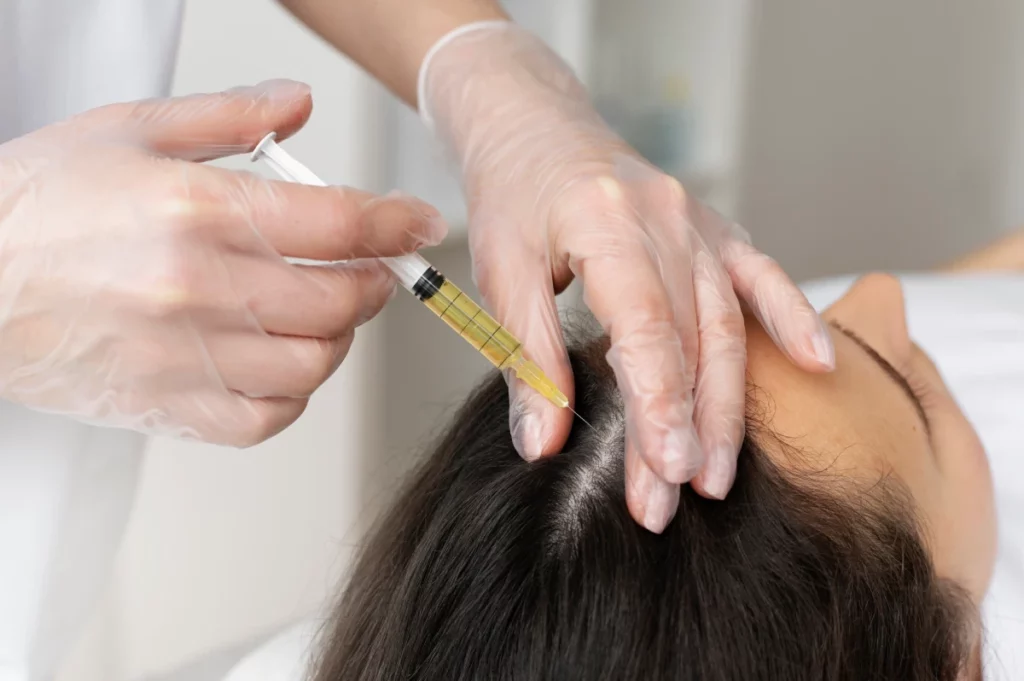
Platelet-Rich Plasma (PRP) is a widely used non-surgical, non-hormonal treatment for hair loss, offering a regenerative approach using the patient’s own blood. Current evidence supports its role in selected patients, with important caveats.
Who does PRP work for?
- Best evidence is for androgenetic alopecia (AGA) in both men and women
- Most effective early, while hair follicles are still present and responsive
- Less effective in advanced hair loss where follicles are permanently lost
How PRP works
PRP delivers a concentrated source of platelet-derived growth factors into the scalp, leading to:
- Activation of hair follicle stem cells
- Stimulation of dermal papilla cells
- Prolongation of the anagen (growth) phase
- Reduction in follicular miniaturisation
Key pathways involved include ERK, PI3K/Akt, and β-catenin (Wnt), supported by growth factors such as PDGF, TGF-β, VEGF, and IGF-1.
Together, these improve follicular blood supply, cell survival, and hair shaft thickness.How effective is PRP?
- Around 80–85% of studies report positive outcomes
- Benefits include:
- Increased hair density
- Increased hair shaft thickness
- Reduced shedding
- Around 15–20% of patients show minimal or no response
PRP is not inferior to minoxidil or finasteride in many early-stage cases and may be used:
- Alone, or
- As an adjunct to medical therapy
Combination therapy works best
PRP delivers the most consistent and durable results when combined with:
✔ Minoxidil
✔ Microneedling
✔ Low-level laser therapy
✔ Emerging regenerative approaches (experimental)
In practice, PRP alone is rarely optimal.
Treatment approach
Typical effective protocols involve:
- 3–6 initial sessions
- Treatments every 2–4 weeks
- Maintenance every 6–12 months
For scalp use, leukocyte-poor PRP (LP-PRP) is generally preferred due to better tolerance and lower inflammatory risk.
Safety profile
When performed correctly, PRP is very safe:
- No hormonal or systemic effects
- No sexual side effects
- Compatible with other hair loss treatments
Side effects are usually mild and local:
- Temporary discomfort or swelling
- Mild redness
- Rare infection (almost always linked to poor aseptic technique)
Why results can vary
PRP is effective, but technique-dependent. Suboptimal outcomes are most often due to:
- Poor PRP preparation or quality
- Incorrect diagnosis or advanced hair loss
- Unrealistic expectations (PRP strengthens follicles but does not create new ones)
- Too few sessions or lack of maintenance
- Failure to combine PRP with other treatments
This explains why outcomes differ widely between clinics.
Why medical expertise matters
PRP is not just a cosmetic procedure – it involves diagnosis, blood handling, biological processing, and injections.
Medically trained doctors provide:
- Accurate diagnosis and patient selection
- Exclusion of reversible medical causes of hair loss
- Appropriate PRP preparation and technique
- Safer delivery with strict aseptic standards
- Ethical expectation-setting and long-term treatment planning
Who performs PRP is often as important as the treatment itself.
Bottom line
✔ PRP is a biologically plausible, clinically effective, and safe option for androgenetic alopecia
✔ Best results are achieved when treatment starts early
✔ PRP works best as part of a combined medical strategy
✔ Outcomes depend heavily on PRP quality, preparation method, and clinician expertise