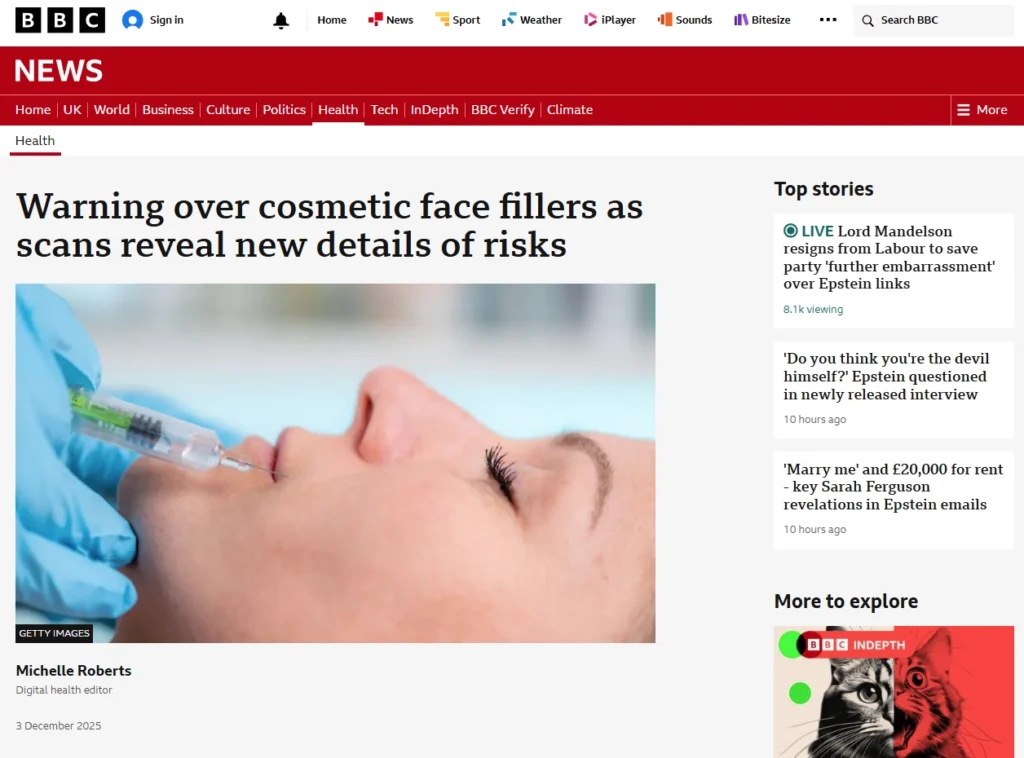
Dermal fillers are now one of the most commonly requested aesthetic treatments in the UK. They are often marketed as quick, low-risk procedures with immediate results. In reality, dermal fillers are medical injections into highly vascular areas of the face, and when complications occur, they can be serious, permanent, and sometimes life-changing.
At OneMedicine, we believe patients deserve clear, honest information about risks – and why UK-trained doctors are best placed to manage them safely.
This article explains what can go wrong with dermal fillers, and why medical training genuinely matters.
- Are dermal fillers safe?
- Common side effects after dermal fillers
- Lumps, nodules and filler migration
- Infection and delayed inflammatory reactions
- Vascular occlusion – the most serious dermal filler complication
- Why choosing a UK-trained doctor matters
- When to seek urgent medical help after fillers
- The OneMedicine approach to dermal fillers
- Final thoughts
Are dermal fillers safe?
When performed correctly, using appropriate products and conservative technique, dermal fillers can be safe and effective. However, safety depends far more on who injects the filler than on the filler itself.
Most serious complications arise from:
- Poor anatomical knowledge
- Incorrect injection depth or location
- Failure to recognise early warning signs
- Inability to manage medical emergencies
These are not cosmetic issues. They are clinical ones.
Common side effects after dermal fillers
Pain, swelling and bruising
Mild swelling, tenderness and bruising are common, especially around the lips, tear troughs and nasolabial folds. These usually settle within a few days.
However, severe pain during injection or pain that worsens rather than improves is not normal and may indicate vascular compromise.
Asymmetry and overfilling
Poor technique or overuse of filler can cause:
- Facial asymmetry
- Distorted proportions
- An overfilled or unnatural appearance
Once excessive filler has been placed, correction can be complex and sometimes requires dissolving and repeat treatment.
Lumps, nodules and filler migration
Lumps and nodules
Fillers may feel lumpy if injected too superficially or unevenly. Some lumps settle with time, but others become firm inflammatory nodules weeks or months later.
Delayed nodules often require:
- Medical assessment
- Prescription medication
- Careful dissolving using hyaluronidase
Incorrect management can worsen inflammation and scarring.
Filler migration
Fillers can move away from the original injection site, particularly in mobile areas such as the lips. Migration can create unnatural fullness and distortion that is difficult to reverse.
Infection and delayed inflammatory reactions
Infection
Any injection carries an infection risk. Symptoms may include:
- Increasing redness
- Pain and warmth
- Swelling or discharge
Untreated infection can lead to abscess formation and permanent scarring. Proper aseptic technique and early medical treatment are essential.
Delayed inflammatory reactions
Some patients develop swelling, redness or tenderness weeks or months after filler treatment. These reactions may be triggered by:
- Viral illnesses
- Dental procedures
- Immune system activation
These presentations are frequently misunderstood and require medical diagnosis and management, not cosmetic camouflage.
Vascular occlusion – the most serious dermal filler complication
What is vascular occlusion?
Vascular occlusion occurs when filler is accidentally injected into a blood vessel, blocking blood flow. This is a medical emergency.
Warning signs include:
- Severe pain during or shortly after injection
- Blanching or whitening of the skin
- Dusky, mottled or grey discolouration
- Rapid swelling
Without immediate treatment, vascular occlusion can lead to skin necrosis, ulceration, permanent scarring and facial disfigurement.
Blindness and stroke
In rare but catastrophic cases, filler can travel through facial arteries to the blood supply of the eye or brain, causing:
- Sudden irreversible blindness
- Stroke-like neurological injury
These complications are devastating and often untreatable once they occur.
Why choosing a UK-trained doctor matters
Dermal fillers should not be treated as beauty treatments. They are medical procedures, and UK-trained doctors are uniquely trained to manage the risks.
Advanced anatomical knowledge
UK-trained doctors complete:
- A 5–6 year GMC-accredited medical degree
- Foundation training managing acutely unwell patients
- Ongoing revalidation and clinical governance
They have a detailed understanding of:
- Facial arterial anatomy and variation
- Vascular danger zones
- Tissue planes and safe injection depth
Most severe filler complications result from anatomical error, not the filler itself.
Early recognition of danger
Early signs of vascular compromise can be subtle and easily missed.
Doctors are trained to:
- Recognise evolving ischaemia
- Differentiate normal swelling from early occlusion
- Act immediately rather than “wait and see”
In filler complications, minutes matter.
Emergency management and prescribing authority
When complications occur, UK-trained doctors:
- Understand high-dose pulsed hyaluronidase protocols
- Can prescribe and administer emergency medication
- Can manage anaphylaxis, collapse and severe pain
- Know when and how to escalate urgently to A&E or ophthalmology
Many non-medical injectors do not have prescribing rights or emergency training.
Regulation and accountability
UK doctors are regulated by the General Medical Council, meaning they are:
- Held to national professional standards
- Required to carry appropriate medical indemnity
- Subject to investigation if care falls below expected standards
This level of governance protects patients when outcomes are poor.
Long-term complication care
Not all complications appear immediately.
Doctors can manage:
- Delayed inflammatory nodules
- Biofilm-related reactions
- Infections requiring antibiotics
- Immune-mediated swelling
- Complex dissolving without unnecessary tissue damage
They can also identify when symptoms suggest a non-aesthetic medical condition requiring further investigation.
When to seek urgent medical help after fillers
Seek immediate medical attention if you experience:
- Severe or worsening pain
- Skin whitening, dusky discolouration or blistering
- Sudden visual disturbance
- Rapid swelling or signs of infection
Early intervention can be skin-saving and sight-saving.
The OneMedicine approach to dermal fillers
At OneMedicine, dermal fillers are delivered within a doctor-led medical framework, not a beauty setting.
Our focus is on:
- Conservative, anatomy-led treatment
- Thorough medical assessment and consent
- Immediate access to emergency management
- Long-term patient safety over short-term cosmetic trends
Final thoughts
Dermal fillers can achieve excellent results when performed well. But they carry real medical risks, including:
- Vascular occlusion
- Skin necrosis
- Permanent scarring
- Blindness
For this reason, patients should strongly consider treatment by a UK-trained doctor with the knowledge, skills and accountability to manage complications safely.
If you are considering dermal fillers and want medically led care, informed consent and safety-first treatment, OneMedicine is here to help.